
Greg “Boom” May Q&A Part 1

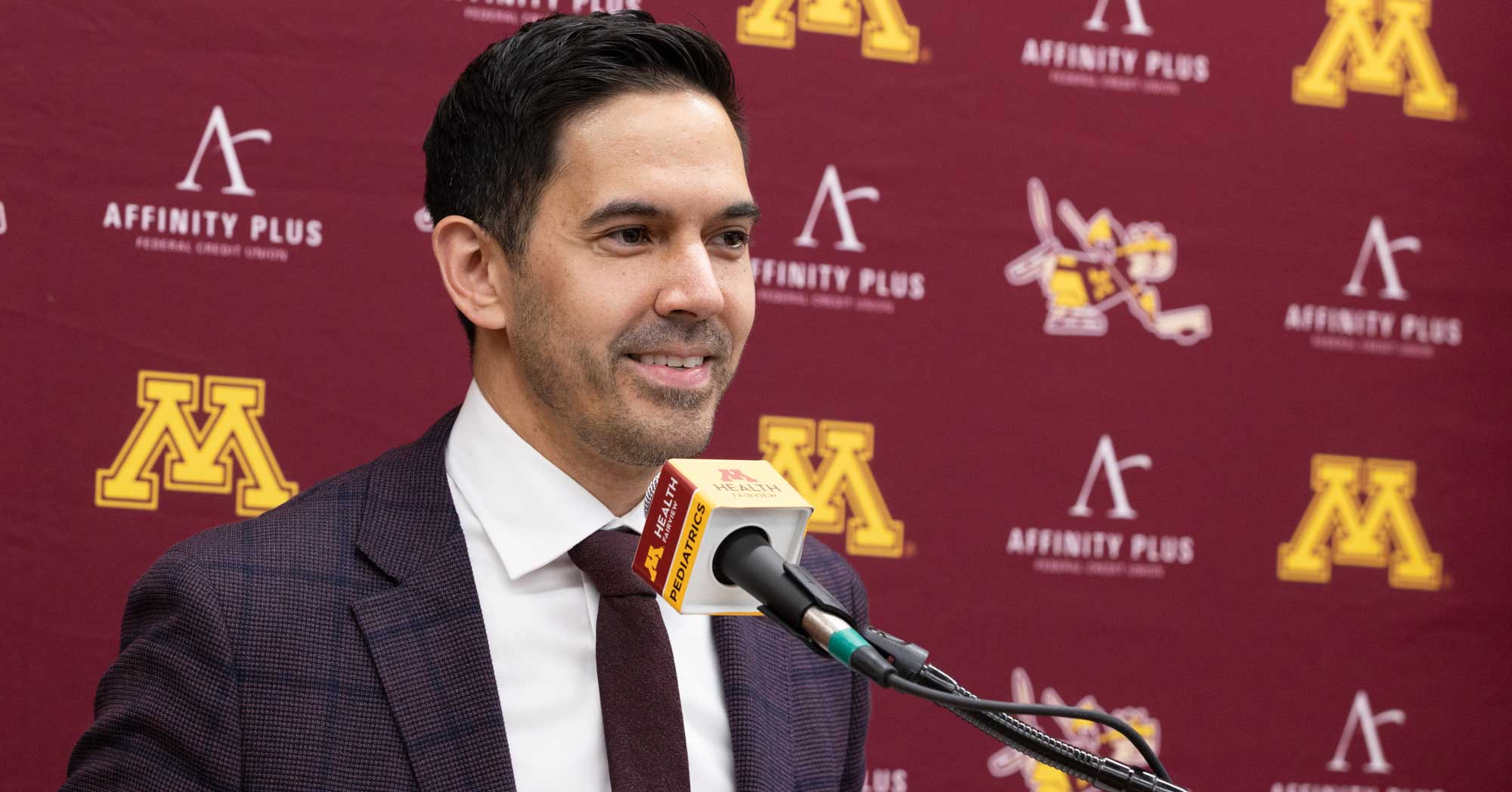
Becoming the head coach of Gopher Women’s Hockey and writing a new chapter in the programs storied history.
Game one against Bemidji State will mark the beginning of a new era of Gopher Women’s hockey; for the first time in 19 seasons, the Gophers will have a new head coach. In the offseason, the Gophers parted ways with Head Coach Brad Frost and hired Frost’s former assistant Greg “Boom” May to replace him. May is now tasked with returning Minnesota to the pinnacle of college hockey, a place they haven’t been since 2016.
Last week, Gopher Puck Live caught up with Coach May before the season begins. In part one of our Q&A, I asked Coach May about his transition to the head coaching role, how his diverse experience has prepared him for the role, where he believes the program can improve, and the challenge of building on the program’s past success.
Some questions and answers have been edited for clarity and length.
What have the past couple of months been like for you? Any unexpected challenges now that you have taken over as head coach?
Yeah, great question. I don’t think that there’s anything that I haven’t expected. Obviously, the new challenge is time. You’re getting pulled in many different directions. But all good stuff. Whether it’s interviews or meeting with donors or speaking with alumni, there are a lot of things that, when you’re in the assistant coach role, you know what goes on, but you don’t understand how much of it is going on, I guess. Meanwhile, you’re still trying to get your team off the blocks and running as well. So, nothing that I haven’t known, or no real big surprises. It’s just more a matter of finding time to do everything.
You have a pretty diverse coaching background. You’ve also worked in hockey operations, as an athletic director, and as a teacher. Does that diverse background maybe help with some of those new responsibilities as a head coach?
Absolutely. I would say every single one of those stops I’ve had along the way has played a role in my comfort level on that side of things. I taught for 9 years. I’ve been an athletic director. I’ve been an assistant athletic director. I’ve been a director of hockey operations. I’ve been an assistant coach. I’ve been a head coach across all different levels too, from youth hockey to high school, division three, division one, men’s and women’s. I do think that’s benefited me a lot in terms of comfort level with all the intangible things.
I’d imagine that diverse experience helps you relate to players of different ages, nationalities, or backgrounds?
Yeah, I agree. I taught elementary. So I spent nine years in an elementary school setting, and to go a step further, it was in a gym setting. When those gym doors open, those students, for lack of a better word, feel entitled to be crazy for 45 minutes straight. To your point, it’s all walks of life. From socioeconomic status to cultural backgrounds to everything you name it. In the elementary school, when I was there, it was kindergarten through sixth grade. So I had 5-year-olds all the way to the 12-year-olds that were the kings and queens of the school.
Then, going all the way up to my division three men’s team, my last year there, we didn’t have one player who was under 21 years old because it’s all players that age out of junior hockey and division one transfers. I’ve definitely had experience across the gamut from an age standpoint and a diverse background standpoint, whether it’s skill or gender or just background in general.
This team has had so much success these past couple of years. I’m curious, as head coach now, how do you balance not taking that success for granted while also knowing the fans, and the university, expect more?
Yeah, I think I don’t know the answer yet. I think what we’ve been doing is not shying away from talking about it, not shying away from talking about the pressures and the expectations that are here at Minnesota. The reality is that all of us coaches here in Minnesota and every player that chose to come to Minnesota, a large part, if not the largest part, is because of those opportunities and expectations. The players and the coaches here know that we have a chance every year. It’s obviously now our job to uphold those standards, and maybe even take them a step further. I think we’re okay talking about it, and not to the point where we’re putting undue pressure on our players or making them grip the sticks too tight, but just the understanding that it is real, and it is a thing.
There are so many positives that come out of that, too. Our media market is unbelievable, right? The exposure that our players and our program get is honestly probably second to none. Now I haven’t worked at the other 40-plus schools in the country, but I have to imagine it’s [our media exposure] second to none: the radio exposure, the newspaper exposure, and TV exposure. PJ Fleck, head football coach, mentions this often, but he’s a football coach who works at a hockey school. There are a lot of schools that are football schools that have hockey, and we like to say we’re a hockey school that has football.
There are a lot of expectations that we have, but again, we’re okay talking about it. The balance, of course, comes with [the fact that] winning is really hard to do. Sustaining that winning mentality is really hard to do. You have to make sure you continue to celebrate all of your wins. It doesn’t matter if you’re favored. It doesn’t matter if you’re an underdog. It doesn’t matter if you know it’s gonna be a coin flip. Winning is hard to do. In our league, it might even be that much harder than some other leagues around the country. So we just need to make sure we’re celebrating those successes as well. Even to the point of, yes, has it not been good enough? Yeah, it hasn’t been good enough. We have had a lot of success here in these last few years as well. And just making sure that our players don’t lose sight of that.
Wisconsin and Ohio State have separated themselves from the WCHA and the NCAA as a whole in recent years. The Gophers have competed with those teams and been one of the few teams to beat them in the past couple of seasons. From your perspective, what do you guys need to do, or need to do slightly better, to compete with Wisconsin and Ohio State more consistently?
Yeah, it’s no question that those two programs are on a serious run right now. If I were a betting man, I would say that they’re probably not slowing down either. You know, I tell people this very often, but we’re close, and we’ve been close. And to your point, we’ve beaten these teams these last few years. I would say one thing is that when we do beat them, it shouldn’t be like we just won the Stanley Cup. It should be just another win. We should be so confident in ourselves and our abilities that, yeah, we beat Wisconsin. Yeah, we beat Ohio State, but we’re expected to. Just like they are against us.
I think from a play standpoint, or I guess approach standpoint, we just need to increase our structure with how we play. Particularly without the puck. The structure that we’re in, and how we’re gonna get pucks back and are positioning in our stick detail. Honestly, a lot of it is work. Our players, they all think that they work hard, and they do. They do work hard. But there’s another level when you think about what the word compete means. Everybody works hard. I’m not saying you’re not sweating; I’m not saying you’re not going as hard as you are, but is there another gear of compete? I think the answer is, yes, there is. Now it’s our job as coaches to squeeze that out of them, and it’s their job as players, and especially the leaders on our team, to recognize that, and really start to hold themselves and each other accountable for that as well.
Discipline is another thing that I think comes up, and that goes with structure as well. It’s discipline in the penalty box area, but it’s also discipline in what you’re supposed to do in each moment. If the play calls for stopping and starting, even though you don’t want to stop and start, the disciplined person stops and starts. If we have the puck, and we’re going against our opponent, and they have numbers back, so it’s an odd-man rush not in our favor, if you will, the disciplined player needs to put that puck in a spot, and we need to go get it. Versus trying to stickhandle through the wall that they’ve built at the blue line and turn it over. There are so many different areas of discipline. Discipline on your face-off responsibilities, on wins, on losses. I think that the couple of things that we’re trying to do right now is really teach our players what it means to compete consistently.
You hear coaches at every level, high levels, especially say this, but our practice should be so hard that when it gets to the game, the game is actually kind of easy because we’ve been practicing this hard for four or five straight days leading up to it. On top of competing, it’s the understanding that, yes, we want to be creative. Yes, we want to go have fun offensively, but we have to be disciplined in structure and have structure with how we’re playing the game, especially when we don’t have the puck.
Is that maybe a unique challenge about being at a place like Minnesota? You have incredibly skilled players, and this is maybe the first time in their career that they’ve really had to focus on those details like discipline, structure, and D-zone positioning?
Yeah, I think you’re right about that. We’ve used this term before; I actually stole it from Will Hardy, the head coach of the Utah Jazz. I heard him speak recently and he was talking about his own players but I used it with our team the other day that everybody has a scrapbook. All of them were their team’s best players. They’ve all been their team’s captains. A number of them have been on U18 teams. We have players that have played in the Olympics, players that have been on World Championship teams, won gold medals, and so on.
These players that we’re getting, oftentimes, especially in their youth hockey and their prep hockey days, they’re getting away with things to your point. They don’t have to stop and start, because if they don’t, guess what? The coach is going to throw them over the boards next shift. If they don’t run their correct route on the forecheck, the coach’s gonna throw them over the bench anyway. A lot of times it’s because they’re the ones who are the most productive players statistically on the ice and coaches want to win and they’re not gonna hold them accountable because they’re putting pucks in the net and ultimately you need pucks in the net to win games. So, yeah, I don’t think you’re wrong on that at all.
The nice thing is that it’s a fresh start right now. We lost a number of players. We lost three All-Americans. Even our coaching staff is new as well. So the new voices, some of the fresh expectations, if you will, I don’t want to say it’s made it easy, but it’s allowed us to kind of put the hammer down. Then the other part of that too, which is a really unfortunate circumstance with Coach Frost, he’s one of my best friends to this day still. You know, he gets let go at the end of the year when his contract doesn’t get renewed. That’s a very big wake up call to all of us, including myself, who was on his staff of like, holy crap, this isn’t good enough. Some types of tweaks have to happen. For our players who all decided to come back this year and not go in the portal, and the ones we got in the transfer portal, and our recruits that we were able to retain, they also understand and feel that same need to do something different this year as well.
Stay tuned for part two of my Q&A with coach May where we dig into the 2026-2027 roster. In part two, read Coach May’s thoughts on the strengths of this year’s squad and how they will make up for the loss of three All-Americans.
Greg “Boom” May announced as the new University of Minnesota Women’s Hockey Coach